
Tuesday, March 10, 2015
The Painting Life
If anyone is interested in taking a weekend long, intensive workshop from me, I'll be teaching one at the Appalachian Center for Craft this Summer. If you're interested check it out here

Friday, January 23, 2015
Cross Over: On the Future of Drawing & Painting Education
As a traditionally trained painter and draftsman, the use of computer drawing tools has seemed at best not applicable and at worst anathema to my art training. However the incorporation of digital drawing and painting technology into the traditional studio seems inevitable. This inevitability will probably aggravate and sadden the purists teaching today, but I have begun to see major areas where traditional and digital drawing techniques intersect. This has done more to excite the educator in me than the artist, but I imagine I will start using it as a tool in my painting process at some point. As an educator I have only taught a handful of students that are interested in my specific major (Painting), and of those I haven't taught one that is specifically interested in the things that interest me. This is a good thing. Making Studio Art appeal to broad swaths of the population is challenging, but extremely rewarding when you're able to see how painting, industrial design, and chemistry majors are all engaged by the subject matter. The majority of my students (at least at the time) were pursuing photography and graphic design, many of which were great students but questioned how they could use the course material in their career. Since beginning this foray into the digital realm I have begun to find answers to these questions, and have been considering the possibilities of merging the two worlds in a studio program. I haven't found the exact answer to how one would combine traditional and digital approaches into a single studio context, but I understand that it is the future of the medium. I don't think for a second that Painting will be replaced by the medium known as "Digital Painting", because the products are too different, but I have found that the techniques used in Digital Painting have the potential to be extremely useful in Painting pedagogy.
The extent of my experience at this point has been limited to Adobe Photoshop and Illustrator, with some use of a Wacom drawing tablet in each program. The majority of what I'd like to talk about involves Illustrator, but I think that I have only begun to explore Photoshop's applicability for painting, so there may be an update to this post in the near future.
I was immediately struck by the similarities between building up painting and a vector illustration. To begin I didn't place any limitations on myself as far as how many colors I could use because I had no plans to print the result. I think that is an important difference between how a painter should use the program versus a designer or printmaker. I used a portrait of a friend and examined the image for it's essential values, colors and shapes in exactly the same way. First I outlined contours of the face of a similar value and hue, starting with lighter values and layering increasingly darker tones on top. After completing my first vector illustration I felt like the process would be very beneficial for any painting student, but especially for graphic design students struggling with the concepts of painting. Below you will find a few of the first vector illustrations I have made, the third is really intended to emulate building up a portrait as a painter would, shape by shape.


Achieving the correct value range is the most important aspect of creating dimensionality, and it is most often the most difficult thing for students to understand. Very often the issue is that even if students see the correct values, they blend all of the paint in an object to achieve something that, at best, looks like a Linear Blend on Illustrator but doesn't actually communicate any planar shift. I believe that students would be more prone to not make this mistake if they:
-make vector illustrations from photographs with pronounced light sources
-with at least 6 different and distinct values
-with at least 6 different and distinct hues
-and create at least 3 of these vector illustrations
The second technique with digital and physical applications is planar analysis. Often called Polygonal drawing when created by a computer, it is the same idea, breaking down planes of an object into its essential polygons (non organic shapes). I have found that students have a very difficult time with this assignment, particularly when asked to draw a complicated object. However I believe that this difficulty is largely a result of physical limitations to beginning students. Planar analysis drawings from life are very difficult, but they are extremely helpful in drawing and essential to painting. Using Illustrator to create Polygonal drawings would eliminate the physical restrictions and allow the students to make more accurate renderings. The drawback is that, if students are making these drawings directly from a photograph then they are ultimately robbing themselves of developing their hand eye coordination with regard to physical mark making. However, while I believe that that is true to a certain extent, the most important thing that students can develop in a Drawing class is their ability to SEE. If students are able to understand planar shifts from a photograph then they will certainly be able to see them from life. The key here is not allowing students to turn in unacceptable renderings. A quick google search of polygonal portraits will reveal a glut of examples of "digital artists" not understanding how planes work. Behold, I give you some of those examples (note: these are just some of the first images I found on a google image search, i have no idea who the artists are):


To avoid this catastrophic failure any drawing or painting studio that incorporates digital tools must develop both approaches simultaneously. I think the key is to keep digital programs in the right place. They will not and cannot replace the art object, but they can help you to build the art object better. If students can correctly decipher planar shifts their understanding of the three dimensional world will be greatly enhanced, which will most certainly improve their art making skills in general. Below I have attached a polygonal portrait I made of my father as well as two planar analysis drawings that I made from the same photograph.


In the process of making this piece, I came to realize that if students learned how to break down the planes of the face in this manner they could translate that into making paintings in the tradition of Lucian Freud, Euan Uglow, Jenny Saville, Ann Gale, Hanjo Schmidt and a host of others.


In the process of making this piece, I came to realize that if students learned how to break down the planes of the face in this manner they could translate that into making paintings in the tradition of Lucian Freud, Euan Uglow, Jenny Saville, Ann Gale, Hanjo Schmidt and a host of others.
Jenny Saville
Lucian Freud
Euan Uglow
Ann Gale
Hanjo Schmidt
When I attended undergraduate I never thought that these Digital tools would be used in tandem with a traditional Painting or Drawing class. As a graduate student I only feared that they would be, but now as a professor I can see that they most certainly will be. It is only a matter of time. Seemingly every other field of visual arts (save ceramics) has been aided by the incorporation of digital technology, it is foolish to think that it will not affect painting or drawing. The question then, is HOW will it be incorporated? How do you construct a class that is partially painting studio, with its toxic fumes and messiness with expensive machines. How does a professor cover the basics of Adobe Illustrator on top of teaching all of the intricacies and particularities of oil painting?
I have some ideas about how to handle these questions, and will address them in another post, but the truth is that it will probably mean that a Painting Student has a vastly different kind of education in the future. I believe that this change will be for the better of students and Painting as a medium. Change is good, it is a sign of life, it is an exciting time to be an Art Student. Let's see what the future holds.
Monday, November 24, 2014
Drawing
Since August I have not had access to a studio space. Because of this I haven't been able to make paintings, but that hasn't restricted me from creating work. I've been investigating and experimenting with drawing, although I have always made drawings, they were usually simply in support of a painting. I think this is a fine use of a drawing, but i also appreciate the aesthetics of drawings that stand alone. So I decided that it was time to jump back in to this primary mode of expression. Before I found myself in my current sans studio state i was excited about being restricted to making drawings. I can produce them relatively quickly, I can approach an image in several different ways, and I have a lot of freedom to make something different from anything i've tried before.
To break down the process a little bit, I use painters tape to adhere a piece of drawing paper to foam-core. This gives me a rigid, but soft surface to press against, allowing me to have a huge value range. This also allows me to work on the drawing in a much more casual manner, since I am not strapped to an easel I can move to a comfortable couch and sit down to draw, or move rooms when there are too many distractions. To allow for more mobility I am using graphite exclusively, because charcoal would make too much of a mess.
Before I begin each drawing I begin with a grid system on the paper, this helps me with the placement of composition. I could erase it when I have the final product, but I like maintaining a kind of history to the drawing. You can see it a little bit in these drawings from 2012.


%2Bcopy.jpg)
The Starry Heavens Above and the Moral Law Within
35" x 42"
One Among the Many
24" x 30"
These drawings were really great to do, and I really like them, but they are a little more straight forward, and the paper is adhered directly to a very heavy wooden panel. So they aren't as mobile. I want my drawings to play with dimensionality and flatness in the same way that my paintings do. So I made this drawing, also in 2012.
Some Sort of Ghost in the Machine
36" x 24"
I loved focusing on the contours and line weights, with just enough dimension to make it stand out. This drawing became the inspiration for the work that I would make a couple years later.
How Far Then, Shall We Say, That the East is From the West
24" x 36"
This is the first and last drawing I made at my studio space in Minneapolis, it is also the last drawing I made on an easel. The paper was stretched and glued over a very heavy, but beautifully made (if i do say so myself) panel, prior to drawing. I wasn't initially going to leave the background as simple as it is, but I was planning on making the clothes less detailed. I'm really happy with the drawing as it is, but I've learned that there is a real art to understanding what NOT to do. I'm still learning that.
Below are the three drawings that I have made since i've been without a space. The first is a study for what will be more like the two drawings above, but it was really fun to play with mark making, and seeing how much information i could convey while keeping a loose hand. The other two are pieces that kind of occurred to me, as if I knew exactly how I was going to approach them as soon as I sat down to draw. This has been a really fun way to approach making images, I think it has weaseled its way into my artistic practice so expect more in the future. in the mean time i hope you enjoy these pieces and check my website for more in the future.
Nature, Red in Tooth and Claw
22" x 26.5"
Mine Eyes are Homes of Silent Prayer
22" x 26.5"
On the Threshold of Distinction
29" x 35"
Monday, July 7, 2014
Drawing Progress


graphite on paper mounted on panel
24" x 36"
2014
Tuesday, September 24, 2013
Inside the Painter's Studio Part II
Upon further review I noticed that I didn’t explain things
that I was thinking about or any of my goals in my previous post about this
work. I took this photograph for
this work shortly after finishing graduate school at Arizona State
University. Upon the completion of
the two works “the Hunger Artist” and “The Past has its Place” I had a vision
for how I would arrange my compositions and the manner in which the space would
interact with the figure. This was
the first painting I made after receiving my MFA in painting, so I wanted to
make a statement about my work and my experience, as well as a comment about
the artistic process in general.
I asked several of my friends and two of the teachers I
studied closely with to join me in my studio to be a part of a painting. It
took only a few moments to get the photographs that I needed to mix together to
create my painting. As you can see in the images below part of my process is to
map out the composition, using a grid system to help me determine the best aspect
ratio for the painting.


I use the photograph as a drawing reference mainly. After I establish my drawing I approach
the painting as an abstract picture plane, thinking about the interplay of
colors and values as I organize the rhythm of the marks.
Approaching the surface in this manner means thinking more
about artists like Cecily Brown than Gustave Courbet, which is to say, I am trying
reference Courbet, not copy him.
So if I think of the way Philip Guston’s early paintings were a
connected patchwork of abstract marks, then I can see the painting as it needs
to be seen, an interaction of colors and marks. The difference is that each mark I make has to work
representationally, formally and conceptually. When I look at Cecily Brown’s paintings, they look
remarkably similar to the organization of Seurat and Jaquin Sarolla y Bastida,
hers are simply less fussy about representation. To illustrate my point I’m including some paintings that may
help explain the way that I visualize the surface.


Philip Guston


Cecily Brown

Georges Seurat


Jaquin Sorolla y Bastida
The background contains many of the paintings that I made
while in graduate school at ASU (nearly my whole MFA thesis show is exhibited
behind the figures) as a way of staking my claim and throwing my hat into the
proverbial art ring. I am also
making a comment on the artistic process, the solitude of the painter, and how
that can mean shutting oneself away from friends and loved ones. It’s about how
there are conversations and interactions that the artist will miss in the
pursuit of the creative act. It’s
about being a part of a community of artists, but having to be apart from that
community to actively engage with the conversations held in that
community. It’s also about making
a mountain of work to finally understand what you kind of work you want to
make.
Below are some images of the Gustave Courbet's The Artist's Studio: A Real Allegory of Seven Years in My Artistic and Moral Life, the painting to which I was paying homage.
Below are some images of the Gustave Courbet's The Artist's Studio: A Real Allegory of Seven Years in My Artistic and Moral Life, the painting to which I was paying homage.


Below is the painting that Gustave Courbet was paying homage to, Las Meninas by Diego Valezquez. It was painted about 200 years prior.
,_by_Velazquez.jpg)
Below are detail images of my painting as well as images of some of the paintings in the background, as well as a study for the finished work.


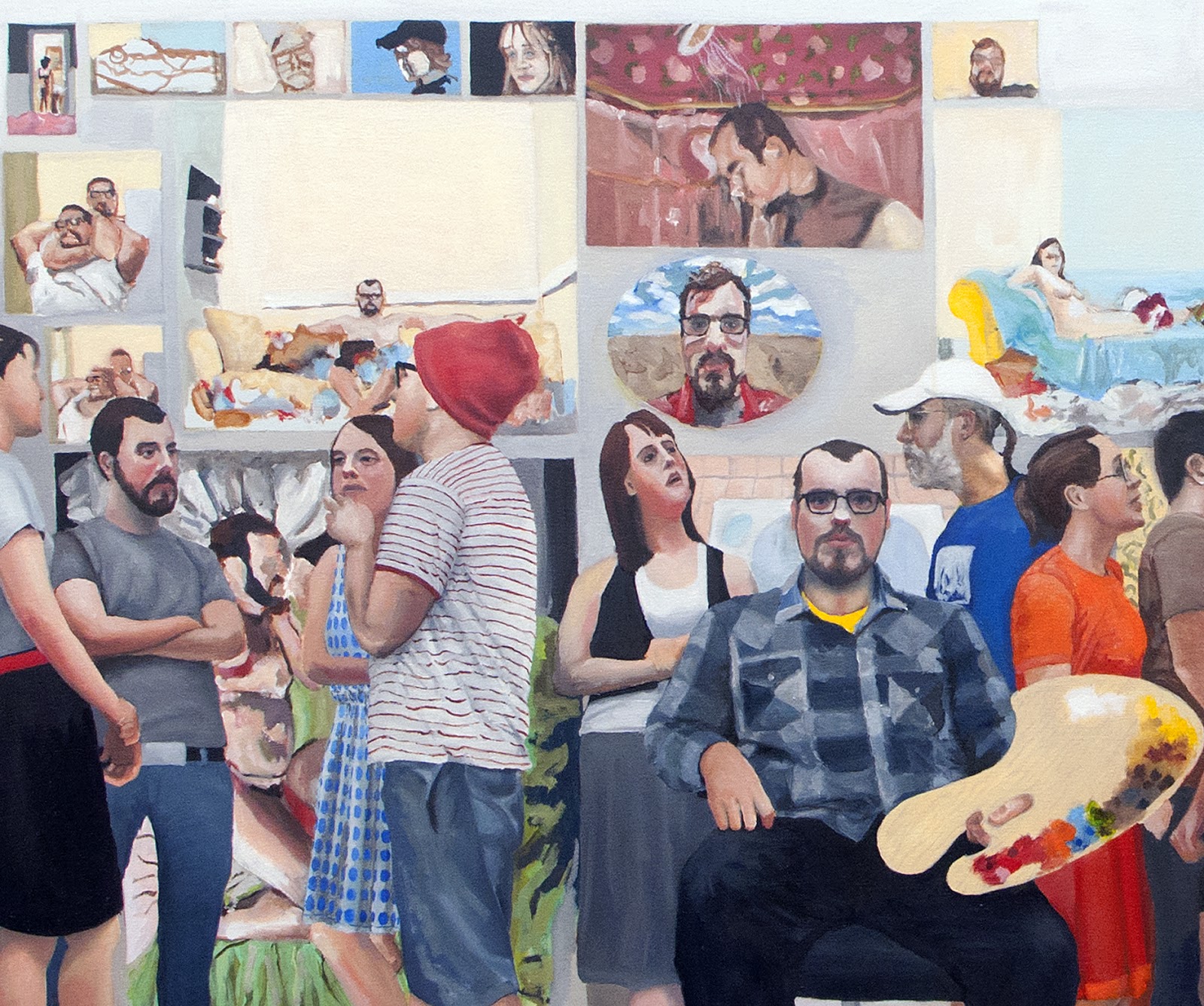


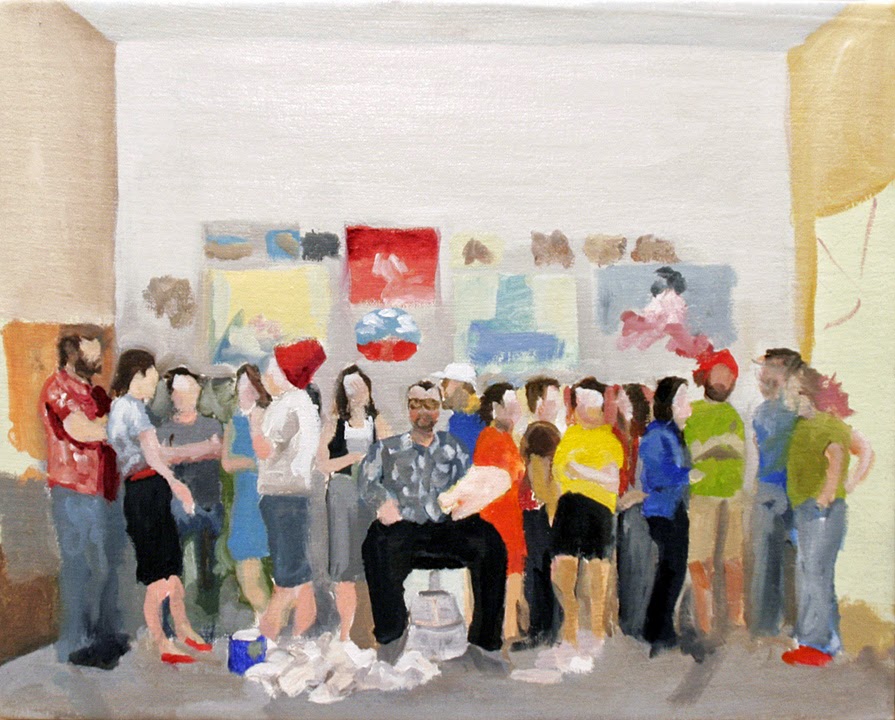

From Left to Right the artists featured in this painting are:
Jerry Schutte
Anne Schutte
Subscribe to:
Posts (Atom)