Monday, November 24, 2014

Drawing

Since August I have not had access to a studio space.  Because of this I haven't been able to make paintings, but that hasn't restricted me from creating work.  I've been investigating and experimenting with drawing, although I have always made drawings, they were usually simply in support of a painting. I think this is a fine use of a drawing, but i also appreciate the aesthetics of drawings that stand alone.  So I decided that it was time to jump back in to this primary mode of expression.  Before I found myself in my current sans studio state i was excited about being restricted to making drawings.  I can produce them relatively quickly, I can approach an image in several different ways, and I have a lot of freedom to make something different from anything i've tried before.

To break down the process a little bit, I use painters tape to adhere a piece of drawing paper to foam-core.  This gives me a rigid, but soft surface to press against, allowing me to have a huge value range.  This also allows me to work on the drawing in a much more casual manner, since I am not strapped to an easel I can move to a comfortable couch and sit down to draw, or move rooms when there are too many distractions. To allow for more mobility I am using graphite exclusively, because charcoal would make too much of a mess.

Before I begin each drawing I begin with a grid system on the paper, this helps me with the placement of composition.  I could erase it when I have the final product, but I like maintaining a kind of history to the drawing.  You can see it a little bit in these drawings from 2012.
The Starry Heavens Above and the Moral Law Within
35" x 42"

One Among the Many
24" x 30"

These drawings were really great to do, and I really like them, but they are a little more straight forward, and the paper is adhered directly to a very heavy wooden panel.  So they aren't as mobile.  I want my drawings to play with dimensionality and flatness in the same way that my paintings do.  So I made this drawing, also in 2012.

Some Sort of Ghost in the Machine
36" x 24"

I loved focusing on the contours and line weights, with just enough dimension to make it stand out. This drawing became the inspiration for the work that I would make a couple years later. 
How Far Then, Shall We Say, That the East is From the West
24" x 36"

This is the first and last drawing I made at my studio space in Minneapolis, it is also the last drawing I made on an easel.  The paper was stretched and glued over a very heavy, but beautifully made (if i do say so myself) panel, prior to drawing.  I wasn't initially going to leave the background as simple as it is, but I was planning on making the clothes less detailed.  I'm really happy with the drawing as it is, but I've learned that there is a real art to understanding what NOT to do.  I'm still learning that.  

Below are the three drawings that I have made since i've been without a space.  The first is a study for what will be more like the two drawings above, but it was really fun to play with mark making, and seeing how much information i could convey while keeping a loose hand.  The other two are pieces that kind of occurred to me, as if I knew exactly how I was going to approach them as soon as I sat down to draw.  This has been a really fun way to approach making images, I think it has weaseled its way into my artistic practice so expect more in the future.  in the mean time i hope you enjoy these pieces and check my website for more in the future.  


Nature, Red in Tooth and Claw
22" x 26.5"


 Mine Eyes are Homes of Silent Prayer
22" x 26.5"

On the Threshold of Distinction
29" x 35"

Monday, July 7, 2014

Drawing Progress


How Far then, Shall We Say, that the East is From the West 
graphite on paper mounted on panel
24" x 36"
2014

Tuesday, September 24, 2013

Inside the Painter's Studio Part II


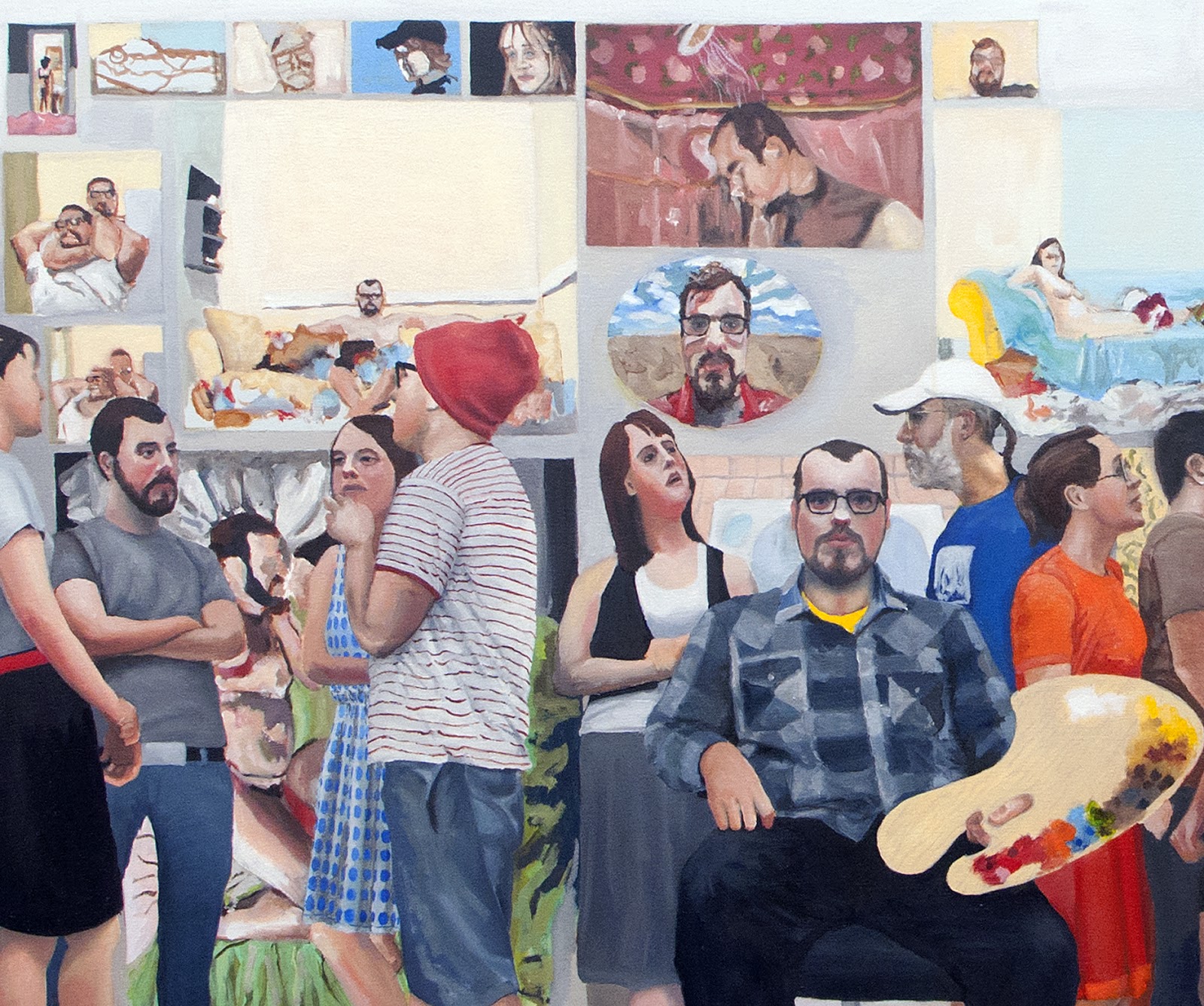
Upon further review I noticed that I didn’t explain things that I was thinking about or any of my goals in my previous post about this work.  I took this photograph for this work shortly after finishing graduate school at Arizona State University.  Upon the completion of the two works “the Hunger Artist” and “The Past has its Place” I had a vision for how I would arrange my compositions and the manner in which the space would interact with the figure.  This was the first painting I made after receiving my MFA in painting, so I wanted to make a statement about my work and my experience, as well as a comment about the artistic process in general. 

I asked several of my friends and two of the teachers I studied closely with to join me in my studio to be a part of a painting. It took only a few moments to get the photographs that I needed to mix together to create my painting. As you can see in the images below part of my process is to map out the composition, using a grid system to help me determine the best aspect ratio for the painting.


I use the photograph as a drawing reference mainly.  After I establish my drawing I approach the painting as an abstract picture plane, thinking about the interplay of colors and values as I organize the rhythm of the marks.   

Approaching the surface in this manner means thinking more about artists like Cecily Brown than Gustave Courbet, which is to say, I am trying reference Courbet, not copy him.  So if I think of the way Philip Guston’s early paintings were a connected patchwork of abstract marks, then I can see the painting as it needs to be seen, an interaction of colors and marks.  The difference is that each mark I make has to work representationally, formally and conceptually.  When I look at Cecily Brown’s paintings, they look remarkably similar to the organization of Seurat and Jaquin Sarolla y Bastida, hers are simply less fussy about representation.  To illustrate my point I’m including some paintings that may help explain the way that I visualize the surface.


Philip Guston


Cecily Brown

Georges Seurat


Jaquin Sorolla y Bastida


The background contains many of the paintings that I made while in graduate school at ASU (nearly my whole MFA thesis show is exhibited behind the figures) as a way of staking my claim and throwing my hat into the proverbial art ring.  I am also making a comment on the artistic process, the solitude of the painter, and how that can mean shutting oneself away from friends and loved ones. It’s about how there are conversations and interactions that the artist will miss in the pursuit of the creative act.  It’s about being a part of a community of artists, but having to be apart from that community to actively engage with the conversations held in that community.  It’s also about making a mountain of work to finally understand what you kind of work you want to make.

Below are some images of the Gustave Courbet's The Artist's Studio: A Real Allegory of Seven Years in My Artistic and Moral Life, the painting to which I was paying homage.


Below is the painting that Gustave Courbet was paying homage to, Las Meninas by Diego Valezquez.  It was painted about 200 years prior.


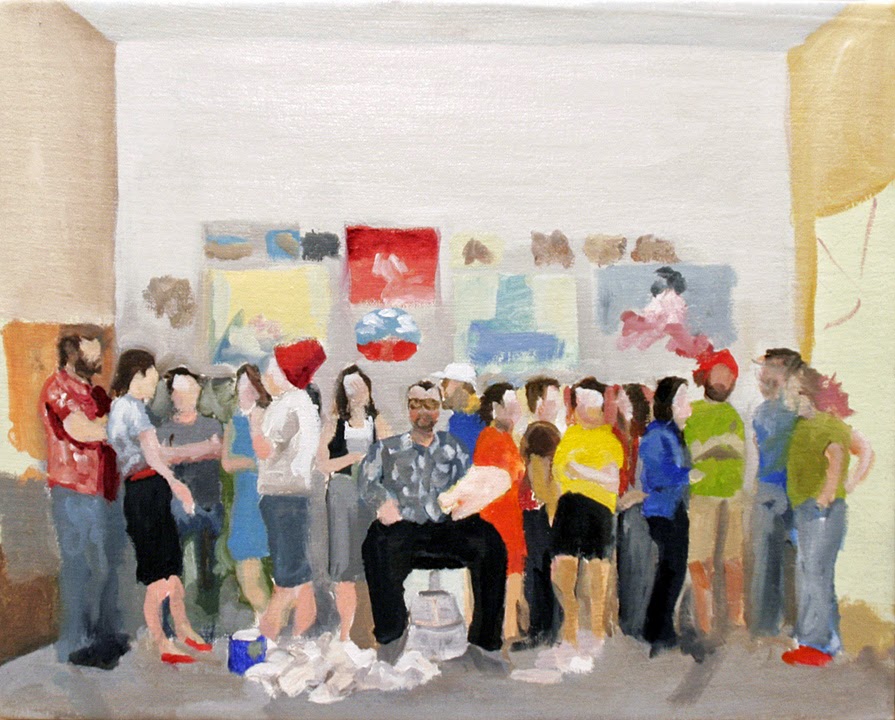
Below are detail images of my painting as well as images of some of the paintings in the background, as well as a study for the finished work. 


From Left to Right the artists featured in this painting are:

Joshua White                     
Kathleen Scott                    
Nicholas Dowgwillo           
Kelsey Wiskirchen             
Ryan Peter Miller                
Sarah Rowland                   
Benjamin Rogers               
Jerry Schutte                      
Malena Barnhart               
Chad Gunderson               
Caroline Battle                  
Anne Schutte                    
Lauren Kinney                   
Ben Willis                           
Mohammad Javaheri       
Patrick Vincent                  

Saturday, March 30, 2013

The Perfect Romance of High Morality

This image was inspired by Jean Francois Millet, Grant Wood, and most notably Jan Van Eyck.  I wanted to do a painting about romance and marriage and love.  Which is interesting because I met my fiancee while I was working on the painting.  This painting was a difficult journey, that took three times as long as it probably should have for a number of reasons.  The first reason is that I needed to restart because my first attempt was awful so after wrestling with it for awhile I ripped the canvas off of the stretcher and started over. 

The second attempt began with a better drawing and a better understanding of what I wanted the piece to be about and how the composition was to work.

As you can see below the final painting varies pretty substantially from the source image photograph.  So I got to do a great deal of invention which is always fun but often risky.  When inventing elements i do so mainly in reaction to what I feel are deficiencies in composition, color flow and conceptual underpinnings.  If I feel that I am not adequately communicating I will try to make myself more clear, without stating plainly what my intentions are.

This painting has references to love and sexuality and how they are intertwined in marriage.  In an era where many people are ambivalent towards matrimony, I see marriage as a wonderful expression of love and commitment that two people make to each other forever.  
With this painting I thought about expressing companionship visually, using complimentary colors to express the complimentary nature of marriage and partnership.  The green couch on the female side represent fertility while the red couch on the male side represents sexual passion.  I realize these metaphors are rooted in traditional gender roles, but that's the kind of upbringing I had, and I think that there is a lot of beauty to them.

In between the couple is some blankets and pillows that is the marriage bed that bridges the gap between male and female, representing sexual congress obviously, but  sex itself is a metaphor for two people acting and moving as one.

There is more to this painting, but I will stop before I explain away every last stitch of mystery.


This is the first painting that I have made with an acrylic value painting as the first layer over which I glaze oil pigments.  This was inspired by teaching introduction to painting at Northern Kentucky University and giving a glazing demonstration to my class.  Though I had done this before, It was right around the time I was tearing the original painting off of the stretcher, so I thought I would try it.  The result is very satisfactory, though the glazed aspects will improve on my next paintings.  I do believe though that this is a very good working method, because I can get everything worked out i terms of value before I really commit to certain aesthetic choices.


Anyway this is the resultant painting, and that was a little insight into the process of making it.  I hope you enjoy it.  


UPDATE
Or at least I thought it was the finished piece.  But after several months I grew unsatisfied with it, my wife encouraged me to work on it, to bring it up to my satisfaction.  so I did.  Then SHE photographed it (she went to the Art Academy of Cincinnati for photography)  so you can see a big difference not only in the over all quality of the painting, but the photograph as well.


I am much more satisfied with it now.  I'm glad that after several months of working on it that I decided to spend an extra week and fix my issues with it.